Hello! Today I’m bringing you an in-depth review and heartfelt analysis of the drama that soaked our hearts in the warmest, most wistful nostalgia — Reply 1988.
Even as time passes and the world changes, there’s a magical work we return to whenever a cold wind blows or a corner of our heart feels empty. That work is Reply 1988 (“Eung-pal” for short), the story of neighbors on a Ssangmun-dong alley.
In 1988, I was a high school student. The drama captured the mood of our generation so well that it resonated with me even more. In my fifties, I went looking for the old house where I lived as an elementary school kid.
I even visited my old elementary school. The alley was so much narrower than I remembered, and the school desks so much smaller. The house had been rebuilt, but the scenery of that time still lingered, and I was able to spend some time reliving those memories.
It was an era full of warmth, where neighbors who lived together along an alley like Ssangmun-dong attended the same elementary school, were sometimes called “the three musketeers,” and even the parents all knew each other well. After elementary school let out, you’d toss your bag at home, and since there were no smartphones back then, you’d go stand in front of a friend’s gate and shout their name — “Hey, so-and-so, let’s play!” — and play until dusk, when your mom came out looking for you to call you home for dinner. There were no computers for games either, so we played ddakji (paper flip tiles), marbles, jachigi (stick game), catching dragonflies, ojingeo-geim (a Korean tag game, “squid game”), kite flying, sending shadows racing, and jegichagi (shuttlecock kicking).
Now, if you climb a mountain in Busan and look down over the city, it seems like apartments make up about 60% of residential areas. Generations born after 2000 don’t really know these close-knit alley neighborhoods.
So why can’t we let go of this drama, why do we miss it so dearly even after all this time? Let’s take a close look at the warmth of Ssangmun-dong we loved back then, the fluttering romances of youth, and the tearful family bonds. Prepare a warm cup of tea, and let’s take a nostalgic trip back to that alley of 1988 together!
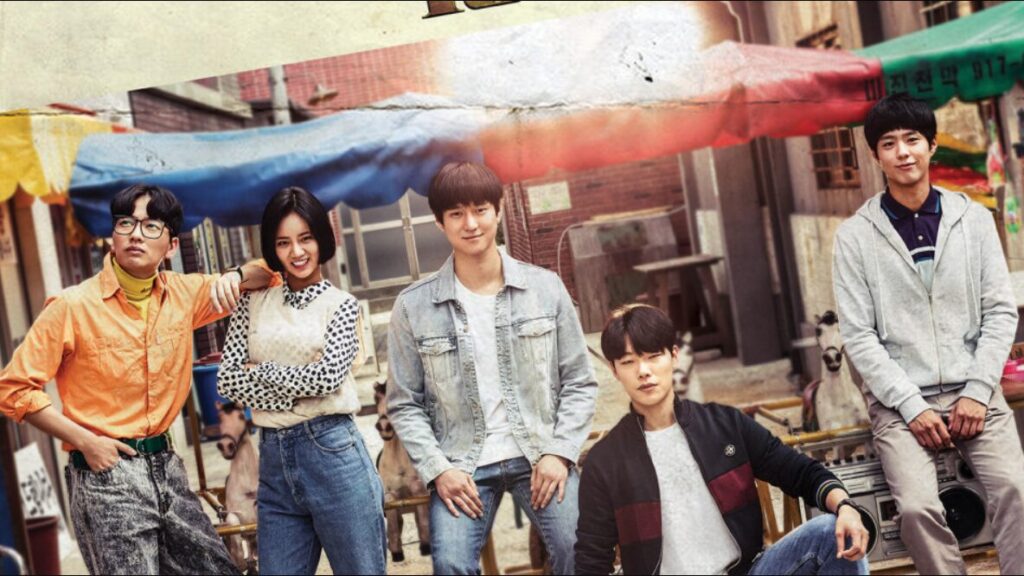
1. What Makes Reply 1988 So Special?
More than a “who’s the husband” guessing game — a record of an era and a life-defining drama
Airing on tvN from November 2015 to January 2016, Reply 1988 was a phenomenon that left its mark on cable drama history.
Its ratings were slightly lower than Crash Landing on You but slightly higher than Goblin. I think this shows it’s a great drama for helping overseas audiences understand the sentiments of our country.
Through this, it built a shared sense of empathy spanning every generation, from teenagers to those in their sixties and beyond, becoming more than just a drama — it became a social phenomenon. The everyday scenes of that era, when the smell of cooking rice filled the alley in the evening and neighbors shared side dishes and chatted on wooden platforms, became a huge comfort to modern audiences.
2. The Vivid Characters Who Filled the Ssangmun-dong Alley
Reply 1988’s greatest strength is undeniably its cast of characters — not a single one is forgettable. Regardless of whether they’re lead or supporting, every character lives and breathes with their own vivid story.
1) The Ssangmun-dong Five Eagles: Our Once-Green Youth
The five best friends who grew up together on the alley, having seen each other at their best and worst, are a group that warms your heart just by looking at them.
            [ The Ssangmun-dong Five Eagles ]
                             │
       ┌───────────┬─────────┼───────────┬───────────┐
       │           │         │           │           │
  [Sung Deok-sun] [Kim Jung-hwan] [Choi Taek] [Sung Sun-woo] [Ryu Dong-ryong]
   (lovable/2nd)  (tsundere/pure)  (baduk genius) (model son) (alley advisor)
- Sung Deok-sun (played by Hyeri): The eternally put-upon second child, caught between her older sister Bo-ra’s nagging and her little brother No-eul’s mischief. But with her bright, lovable personality, she’s the vitamin of the Ssangmun-dong alley. Though not the best student, she’s deeply considerate and warm-hearted, beloved by everyone.”She shows a completely different charm in this drama compared to her days as a singer in Girl’s Day.”
- Kim Jung-hwan (played by Ryu Jun-yeol): Nicknamed “Grumpy Jung-hwan.” He always seems gruff and indifferent, but he’s actually deeply thoughtful and caring. He watches over his parents’ feelings closely, and in front of Deok-sun, whom he likes, his heart pounds even as he acts prickly on the outside — the textbook definition of “tsundere.”
- Choi Taek (played by Park Bo-gum): An unrivaled genius on the baduk (Go) board, a world-class master, but inside the alley he can barely hold a spoon properly or tie his own shoelaces — a living treasure of a klutz. Having lost his mother early and grown up lonely, the Ssangmun-dong family embraces him like their own child and brother.”He was modeled after Pro 9-Dan Lee Chang-ho and blended seamlessly into the drama.”
- Sung Sun-woo (played by Go Kyung-pyo): To his mother Sun-yeong, he’s an irreplaceable, dependable, and affectionate son; to his younger sister Jin-joo, he’s the epitome of a caring older brother. Good at studying, good at sports, and upstanding in character — he’s the alley’s perfect “model son.”
- Ryu Dong-ryong (played by Lee Dong-hwi): Ssangmun-dong’s information hub and mood-maker. Nearly last in his class academically, but a master of social savvy, reading the room, and understanding how the world works. When his friends are troubled, the offhand remarks he tosses out often turn out to be surprisingly wise answers.
3. “Eonamryu” vs “Eonamtaek”: The Love-Timing Debate That Shook the Nation
Reply 1988’s biggest talking point was, without question, “Who is Deok-sun’s husband?” Throughout the broadcast, viewers split into fierce debate between the “Eonamryu” camp — shouting “Her husband must be Ryu Jun-yeol!” — and the “Eonamtaek” camp, who backed Choi Taek. The two men’s very different ways of loving made the show all the more immersive.
The Aesthetics of Missed Timing: Kim Jung-hwan’s Lonely One-Sided Love
Jung-hwan carried a torch for Deok-sun for a very long time. Worried she might be left waiting at the gate on a cold winter day, he’d linger there for tens of minutes fixing his shoelaces; on the bus, he’d brace himself so hard his forearm veins bulged just to keep her steady as it swayed. And yet Jung-hwan always hesitated. He was embarrassed to let his feelings show, and the moment he learned his close friend Taek also liked Deok-sun, he froze in the face of friendship.
“Fate doesn’t come around all the time. If you’re going to use the word ‘fated,’ it should be a dramatic moment that arrives only rarely, by chance. Only then is it truly fate.
But fate’s other name is timing. My first love was always caught at that damn, damn timing.”
While Jung-hwan sat anxiously stuck at a red light, it was Taek — without a moment’s hesitation — who forfeited his Go match and ran straight to Deok-sun. In the end, Jung-hwan comes to realize: what held him back was never the red light or bad timing, but his own endless hesitation.
The scene where Jung-hwan finally confesses the feelings he’d tucked away for so long, half as a joke, then leaves behind a ring and walks away — the “fiancée ring” scene — is remembered as one of the most beautiful and painful full stops on unrequited love in drama history.
The Straightforward Competitor: Choi Taek’s Transparent, Steadfast Love
Taek, who seemed clumsy and naive, turned out to be the bravest competitor when it came to love. He didn’t hide his feelings, confessing openly in front of his friends: “I like Deok-sun. Not as a friend — as a woman.”
This kind of love triangle actually happens often among real-life friend groups. There’s a lot of reading-the-room and pride at stake. Who confesses first matters, but in the end, it’s the woman’s choice. Even friends who grew up together as kids eventually reach a point where the opposite-sex friend becomes something more than a friend, or becomes someone else’s girlfriend and drifts away. That pure, innocent feeling of liking someone as a child is captured beautifully in Hwang Sun-won’s short story “The Shower” (“Sonagi”).
Taek rearranged his most important Go match schedules for Deok-sun’s sake, and would rush to her side the moment she called, even while sick. When Deok-sun wandered, longing to feel loved, it was Taek who made her feel most valued simply for being herself. Unafraid of getting hurt, Taek threw his whole heart into it, and his straightforwardness eventually moved Deok-sun’s heart, completing the thrilling twist known as “Eonamtaek.”
4. The Parents’ Heartrending Stories That Never Let the Tears Dry
If the romance captured the eyes of younger viewers, it was without question the devotion and love of the parents that turned living rooms across the country into seas of tears. Parents willingly setting aside even their own pride for their children deeply moved viewers.
“It’s my first time being a dad too”
Sandwiched between her studious older sister Bo-ra and her youngest brother No-eul, second child Deok-sun was always the one getting the short end of the stick. When even her birthday cake gets recycled from her sister’s, her long-pent-up resentment finally erupts.
Afterward, her father Sung Dong-il quietly hands her a cake he prepared just for his second daughter in front of the neighborhood corner store, and says softly:
“I’m sorry, sweetheart — your mom and I are sorry. We just don’t know any better. This is my first time being a dad too. Could you cut your sister some slack?”
This scene, where a parent confesses that they too are bound to make mistakes and stumble because they are not gods, warmly touched the hearts of every child and every parent watching.
Mothers Who Have No Pride Left in Front of Their Children
When their daughter Bo-ra, a student activist, is at risk of being arrested by police during a protest, her mother Lee Il-hwa blocks the police barefoot in the rain, weeping and wailing. Screaming as if coughing up blood about how good and hardworking her daughter is, this mother’s desperate effort to protect her child stirred every viewer’s heart.
Also unforgettable is the story of Kim Sun-yeong, who has to pretend to be well-off in front of her own visiting mother to hide the truth of her hard, solitary life, after enduring the scorn and hurt inflicted by her fierce mother-in-law who mocked her circumstances. When Sun-yeong finds the letter and the crumpled bit of pocket money her mother secretly left behind, she grips the payphone receiver and sobs like a child, crying “Mom… Mom…” — a scene that struck a chord in every daughter watching.
There was once a time when about a million babies were born every year in Korea (1960–1972), but today that number is less than half. It’s only after having your own children that you truly come to understand your parents’ hearts. It’s common for people, after having their first child, to tearfully thank their own mothers. The feeling of wanting to give everything, and aching over not being able to give more — that’s something you can’t understand until you become a parent yourself.
Most of our human relationships — parent-child and friendships when we’re young, and later bosses at work, in-law conflicts, and marriage — make up the bulk of our lives. Wisdom and resolve are what we need to navigate them.
5. The Alley Community: A Precious Value We’ve Lost
| The Neighborly Warmth of the Ssangmun-dong Alley | Details |
| Sharing side dishes | At mealtimes, someone would always say “Take this over to Jung-hwan’s house,” or “Give this to Taek’s dad” — dishes constantly passed back and forth between neighbors, until the dinner table ended up full of food from other people’s kitchens. A warm, familiar sight. |
| Quiet, unnoticed kindness | When Il-hwa worries, moneyless, about how to pay for her child’s school trip, Ra-mi-ran quietly slips an envelope under a basket of potatoes late at night — help given without wounding anyone’s pride. |
| How to share grief | When Choi Taek’s father suddenly collapses, the whole alley treats it as their own family’s crisis, keeping vigil at the hospital and making sure Taek, left on his own, doesn’t miss a meal — unconditional love from the alley family. |
To modern people who keep their apartment doors firmly shut and don’t even know who lives next door, the Ssangmun-dong alley of Reply 1988 feels like more than just a recreation of the past — it feels like a utopia of warmth we should aspire to. Materially, people back then may have been far poorer and had far less than we do now, but in terms of the emotional richness of caring for one another’s pain, that era was fuller than perhaps any other.
Korea has now become a developed country. I think this drama shows, in a way many countries still striving to develop can relate to, how Korea overcame its once-difficult times. Climbing a mountain alone is hard, and easy to give up on. I believe it’s the bonds we share with others that let us make it all the way to the top. And the root of that bond is family, and neighbors.
6. Wrapping Up This Post: Goodbye, My Youth. Farewell, Ssangmun-dong
In the drama’s final episode, redevelopment forces the neighbors to load their belongings onto trucks one by one and leave Ssangmun-dong behind. Looking at the now-empty, weed-overgrown, silent alley, the grown-up Deok-sun murmurs quietly:
“The reason I want to go back to that time is because the people I love were there, and my youth was there.
Missing the young version of us who will never gather again, I say my final goodbye to that time I can never return to. Goodbye, my youth. Farewell, Ssangmun-dong.“
The reason we still binge-watch and miss Reply 1988 isn’t simply nostalgia for the era of the 1980s. It’s because the show speaks for the most beautiful spring-like memory of our lives — a time when, however clumsily, we protected our friends with our whole hearts, loved our families fiercely, and had neighbors we could share our hearts with, without shame.
When a cold wind brushes your heart, or you find yourself missing the warmth of human connection, why not knock on the door of the Ssangmun-dong alley once more? Its warm lantern light will always be there waiting for you.
- What’s your favorite life scene or line from Reply 1988?
- What did your own 1988 — or your warmest memory of your childhood neighborhood — look like?
Share your precious memories and thoughts in the comments! Likes and comments mean a lot to creators. 😊